
Current Clinical Studies

Phase I Study of E10I Stem Cell Therapy for Type 2 Diabetes: Safety, Tolerability and Preliminary Efficacy
Target population: Patients with refractory type 2 diabetes mellitus whose blood glucose remains poorly controlled despite standard therapy (diet, exercise, and optimal medical treatment).
Indication
- Type 2 Diabetes Mellitus
Key Inclusion Criteria:
- 1. Age 18–80 years.
- 2. Diagnosed with type 2 diabetes per 1999 WHO criteria, with disease duration ≥10 years.
- 3. Female body weight ≥45 kg, male ≥50 kg, BMI 18.5–28.0 kg/m².
- 4. Poor glycemic control (HbA1c ≥7.5%) despite ≥3 oral antidiabetic agents or insulin combined with ≥2 oral agents (standard or maximum tolerated dose for ≥3 months).
- 5. Fasting C-peptide <1.2 nmol/L at screening.
- 6. Women of childbearing age must have negative pregnancy test and agree to use reliable contraception during study and 6 months after; males must agree to effective contraception.
- 7. Willing to adhere to diet/exercise management per Chinese Diabetes Prevention and Treatment Guidelines (2024) and provide written informed consent.
Key Exclusion Criteria:
- 1. Type 1 diabetes or specific types of diabetes.
- 2. Acute or chronic pancreatitis.
- 3. Severe allergy or hypersensitivity to any component of the study drug.
- 4. Prior stem cell therapy.
- 5. Participation in another interventional clinical trial within 4 weeks.
- 6. Diabetic ketoacidosis, hyperosmolar state, or severe diabetic complications (proliferative retinopathy, painful neuropathy, vascular stenosis >50%).
- 7. Severe hypoglycemia events or recurrent hypoglycemia within 6 months.
- 8. Serious systemic diseases (CNS, cardiovascular, hematologic, digestive, endocrine, respiratory, genitourinary, immune, psychiatric disorders).
- 9. Malignancy not considered cured (except basal cell carcinoma, squamous cell carcinoma, or micropapillary thyroid carcinoma).
- 10. Uncontrolled endocrine, metabolic or chronic diseases.
- 11. INR ≥1.3 without anticoagulant use.
- 12. Laboratory abnormalities: fasting glucose >15.0 mmol/L, ALT/AST >1.5×ULN, total bilirubin >1.5×ULN, amylase/lipase >1.5×ULN, estimated CrCl <60 mL/min.
- 13. History of heart failure (NYHA III-IV), unstable angina, stroke, MI, or revascularization within 6 months.
- 14. Uncontrolled severe hypertension (SBP ≥160 or DBP ≥100 mmHg) or hypotension (SBP <90 mmHg).
- 15. Clinically significant ECG abnormalities (e.g., atrial fibrillation/flutter, 2nd/3rd degree AV block) or QTcF >450 ms (female >480 ms).
- 16. Thromboembolic events within 6 months.
- 17. Acute or chronic infections posing risk.
- 18. Severe uncontrolled pulmonary disease (fibrosis, interstitial lung disease, acute exacerbation of COPD, active infection).
- 19. Blood donation ≥400 mL within 12 weeks.
- 20. Positive for HBsAg (unless HBV DNA below detection), HCV antibody, HIV antibody, or syphilis antibody.
- 21. Use of immunosuppressive drugs within 24 weeks.
- 22. History of drug abuse within 24 weeks.
- 23. Heavy smoking (>10 cigarettes/day) or alcohol abuse (>14 units/week).
- 24. Any condition deemed unsuitable by the investigator.
E10I

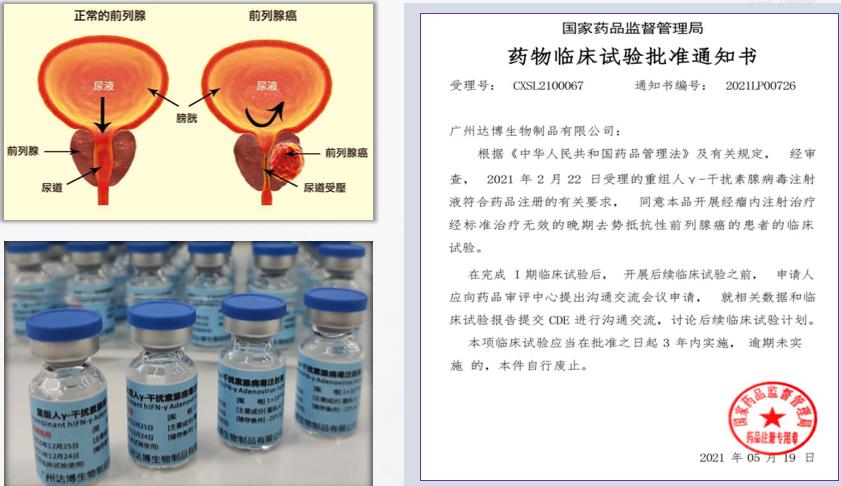
Phase I Study of Multiple Doses of E10B in Patients with Advanced Castration-Resistant Prostate Cancer: Safety, Tolerability and Preliminary Efficacy
We are conducting a phase I study of recombinant human interferon-γ adenovirus injection (E10B) in patients with advanced castration-resistant prostate cancer. Sponsored by Guangzhou Doublle Bioproducts Co., Ltd. and approved by the ethics committee of the First Affiliated Hospital, Zhejiang University.
Study Drug / Specification:
- Name: Recombinant Human Interferon-γ Adenovirus Injection
- Specification: 1.0×10^12 VP/vial
Indication
- Advanced castration-resistant prostate cancer after failure of standard therapy.
Key Inclusion Criteria:
- Male patients aged 18–80 years.
- Histologically confirmed prostate cancer.
- Castration-resistant prostate cancer with failure of standard therapy, defined by: serum testosterone <50 ng/dL or <1.7 nmol/L, and biochemical progression (PSA rise ≥50% above nadir with ≥2 increases, PSA >2 µg/L) or radiographic progression.
- ECOG PS ≤2.
- Life expectancy ≥3 months.
E10B
About Us
- Guangzhou Doublle Bioproducts Co., Ltd. was founded by Dr. Wenlin Huang, a nationally appointed expert, co-chair of the Asia-Pacific Society for Cell and Gene Therapy, recipient of the State Council Special Allowance, and distinguished professor at Sun Yat-sen University Cancer Center. The company focuses on the development and translation of gene therapy, immune cell therapy, and vaccines for oncology applications.
- With a strong commitment to R&D, Doublle Bioproducts has established a comprehensive research system led by Dr. Huang and a team of doctoral-level scientists, collaborating with renowned institutions both domestically and internationally.
- All studies are reviewed and approved by independent ethics committees, strictly following international and national regulations to ensure the full protection of participants' rights and welfare.
Participation Process
Inquiry & Registration
Contact us via phone or online inquiry to submit your interest
Initial Screening
Research staff contact you for preliminary assessment
On-Site Evaluation
Visit the study center for detailed examination and assessments
Informed Consent
Review study details and sign the informed consent form
Study Participation
Undergo treatment and follow-up according to the study protocol
Frequently Asked Questions
Participants may experience benefits such as:
- Access to novel treatments that may be more effective than current standard care
- Close monitoring by a dedicated medical team
- Study-related medical care and investigational drugs at no cost
- Contributing to medical progress that helps future patients
Risks may include:
- Adverse reactions or side effects from the investigational product
- Treatment may be less effective than standard therapy
- More frequent hospital visits and procedures
Before enrollment, researchers will explain all known risks and take every measure to minimize potential harm.
Yes. All personal and medical data will be strictly confidential and used solely for research purposes. Any publications or presentations will not include information that could identify you.